Report
Merger & Acquisition in the Indian Banking Sector
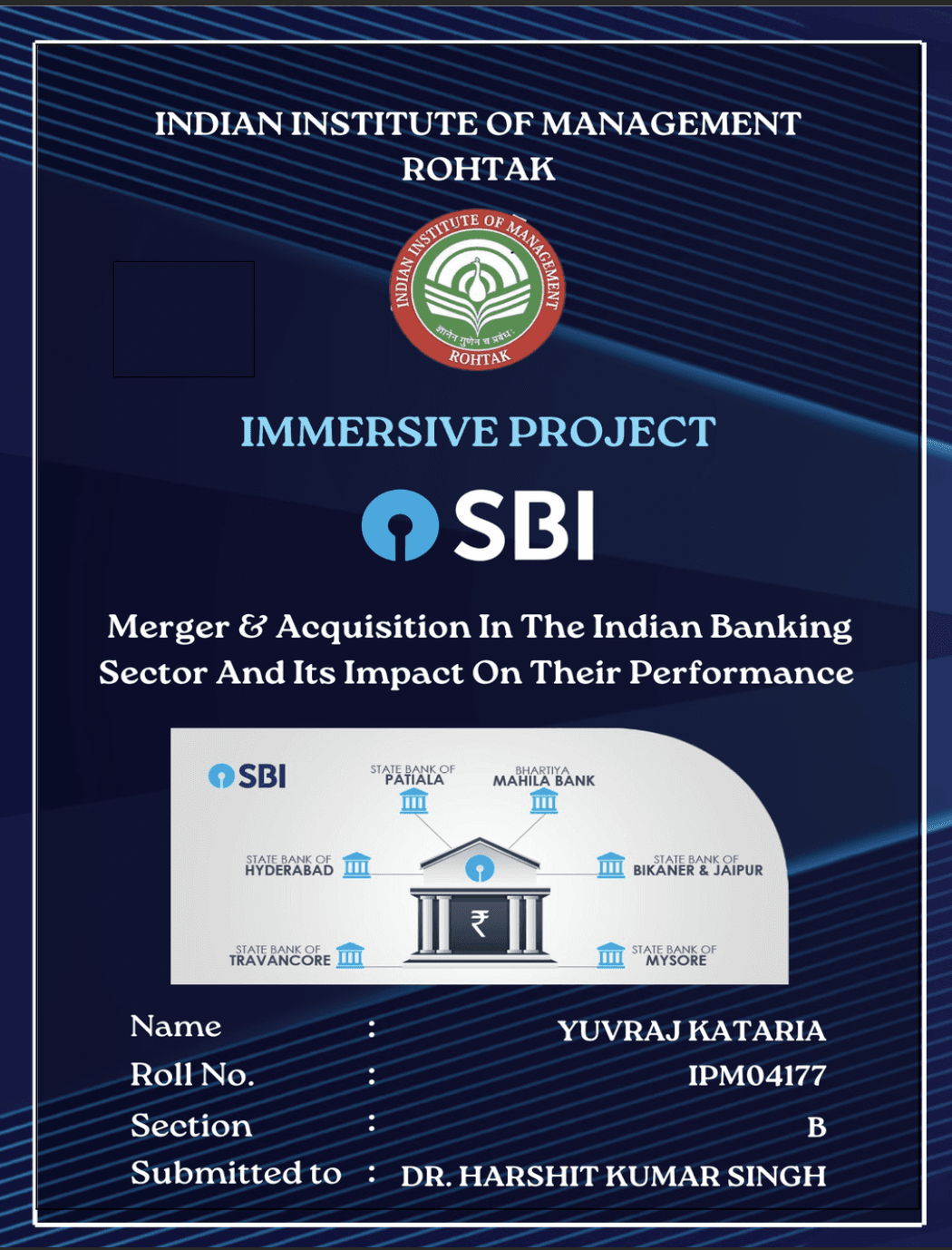
Click on the image above to view the report
Report
Click on the image above to view the report
The purpose of this study is to examine the behaviour of mergers and acquisitions in the Indian banking sector. A number of public sector banks have undertaken this activity mainly to gain from economies of scale. To cope with the recent trend and shift in banking performance throughout the world, corporate restructuring is a critical component in the current financial and economic climate.
SBI is an Indian multinational public sector bank with a branch network of over 24,000 locations, over USD 500 billion in assets, and over 500 million active customers and accounts. The Imperial Bank of India — a descendant of the Bank of Calcutta, formed in 1806 — was renamed State Bank of India on July 1, 1955 after the Reserve Bank of India acquired a 60% stake under the SBI Act of 1955. It's part of the Fortune 500 companies.
The study focused on SBI and its six associate banks: State Bank of Travancore (SBT), State Bank of Mysore (SBM), State Bank of Bikaner and Jaipur (SBBJ), State Bank of Hyderabad (SBH), State Bank of Patiala (SBP), and Bhartiya Mahila Bank (BMB).
Secondary data was utilized, including annual and quarterly financial reports of SBI and its associate banks, stock market data from NSE, Money Control, Screener.in, and StockEdge, and literature from Investopedia, Wall Street Mojo, and Wikipedia for descriptive insights.
A ten-year period was analyzed — Pre-Merger Data: FY 2012–2016, and Post-Merger Data: FY 2017–2021.
Gross NPA, Net Interest Margin (NIM), Profit Margin, Capital Adequacy Ratio (CAR), Return on Assets (ROA), Return on Equity (ROE), Loans to Asset Ratio, Credit to Deposit Ratio, and Earnings Per Share (EPS).
Microsoft Excel was used to compute financial ratios and generate graphical representations for comparison. Statistical testing via T-tests compared pre-merger and post-merger financial metrics, with the null hypothesis (H₀: no significant difference) tested against the alternate hypothesis (Hₐ: significant differences exist).
The null hypothesis (H₀) was rejected for most financial parameters, indicating significant differences between pre-merger and post-merger performance. Parameters like Gross NPA, Capital Adequacy Ratio (CAR), and Earnings Per Share (EPS) showed no significant changes.
The merger of SBI, India's largest lender, with its affiliates was approved to elevate the state-owned entity to compete with global banking giants. The combined institution now boasts assets of approximately ₹37 lakh crore, nearly 24,000 branches, and around 58,700 ATMs across India, ranking it among the top 50 banks globally.
However, the financial performance of the affiliates, including Bhartiya Mahila Bank, was weak prior to the merger, necessitating integration to stabilize operations. Post-merger, SBI experienced declines in key metrics such as EPS, ROE, ROA, NIM, and profit margins due to accumulated losses from the affiliate banks, alongside rising NPAs in 2017 and reduced investor interest. Despite initial setbacks, the merger has positioned SBI as a global banking leader, bringing strategic and economic benefits to the Indian banking sector — though operational and profitability challenges remain as SBI works towards long-term stability and growth.